THE EASTERN CHIPMUNK
(Tamias striatus)
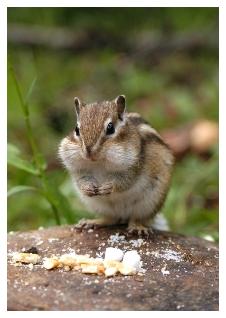
According to Canada's Hinterland Who's Who, the Eastern Chipmunk is easily recognized by the light and dark stripes on the back and head, and is an attractive rodent with grey, black and white stripes on its back; brown, grey, and buff on its head; white underparts; and brown feet.
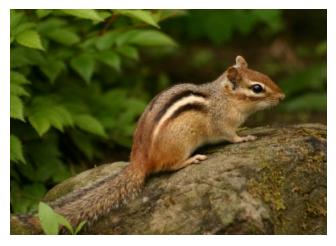
These charming little creatures weigh around 125 grams and have a relatively short tail (about one-third of the total length from its nose to the tip of its tail) and are between 20 and 30 cm long.
Chipmunks are quite vocal and have a wide array of calls, some of which sound like bird chirps, including chirps and squeaks, a high-pitched chip or chuck which is repeated over and over! There is also the scolding noise which is made when they are watching an intruder.
The Eastern variety lives in forested areas in burrows in the ground which is where they gather their food of nuts and seeds.
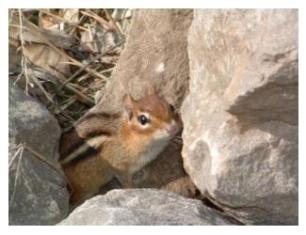
These are great animals to watch - they are so charming that many campers and hikers see them in the woods and are enchanted by their small size, their boldness and their apparent busyness.
In general these animals are solitary and each animals has its own burrow and usually ignores its fellows except during mating season or when conflicts with other chippers arises.
As they spend most of their time in the part of their home range that includes their burrow, this is called their dominance area.
These little creatures live in their nests in well-hidden burrows and tunnels that they have built underground.
They build a nest using grasses, shredded leaves, or the fluffy seed heads of plants.
Seeds and nuts are stored beneath the nest, providing a handy food supply for the coldest part of the winter.
Chipmunks are known to be hibernators, even in the southern parts of their range and by October, each individual has gathered enough seeds to enable it to survive the winter.
In spring with the first warm days of March, they begin to emerge, sometimes burrowing up through a metre of snow.
One of our readers from Fonthill, Ontario, has this to say:
Yesterday I noticed a chipmunk in my backyard, living under a shed. I was excited to see the little guy there and thought my kids would enjoy it as they love to see them up north when we visit. I left out some nuts for it and noticed they were gone by late afternoon. Sadly, this morning my dughter found him floating in the pool. I've never known of these little animals to live this far south in Ontario, but hope to see more of them in the future. It's strange because I've never seen a drowned one up north and there are tons of the friendly buggers running around up there!
Thanks for your contribution - lets hope that there are more of the little fellas around Fonthill!
Predators include the Red Tailed Hawk and Sharp Shinned Hawk, Great Horned Owl , and other hunters such as the cunning Red Fox and the Raccoon.
Chipmunk Info ...
Hinterland Who's Who - the Eastern Chipmunk
A great Canadian site with lots of information about these charming little animals that are such fun to watch!