THE EASTERN BLUEBIRD
(Sialia sialis)
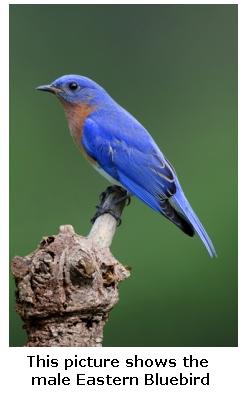
The Eastern Bluebird is a medium sized member of the Thrush family which can be found in the woods, orchards and farm lands of Southern Ontario.
Their numbers have increased in the past few decades, after this pretty bird was in serious decline in the mid 20th century.
This was due to the destruction of their habitat, the use of pesticides, and the loss of their eggs and young to introduced bird species such as Starlings and House Sparrows.
When we drive around the farmland in Southern Ontario, we often see Eastern Bluebird nesting boxes on fences around fields.
I have never seen any of these birds at our backyard bird feeder, so I'm not sure whether they eat any of the food that we put out for them.
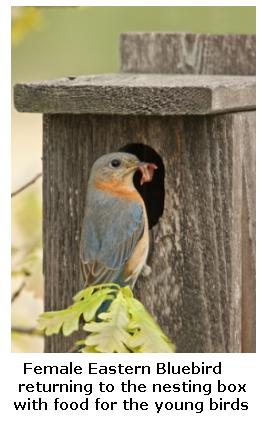
These are likely Bluebird nesting boxes, which are placed by local farmers and bird enthusiasts, and which encourage these lovely birds to nest here in beautiful Southern Ontario.
Sometimes other birds will use these boxes to build their nests and raise their young, but these birds are cavity nesters and requires a specific type of location and habitat.
The life span of Eastern Bluebirds is between six and ten years.
These birds are not common here in Southern Ontario, but are found from Central Saskatchewan through to the Maritime provinces of Canada.
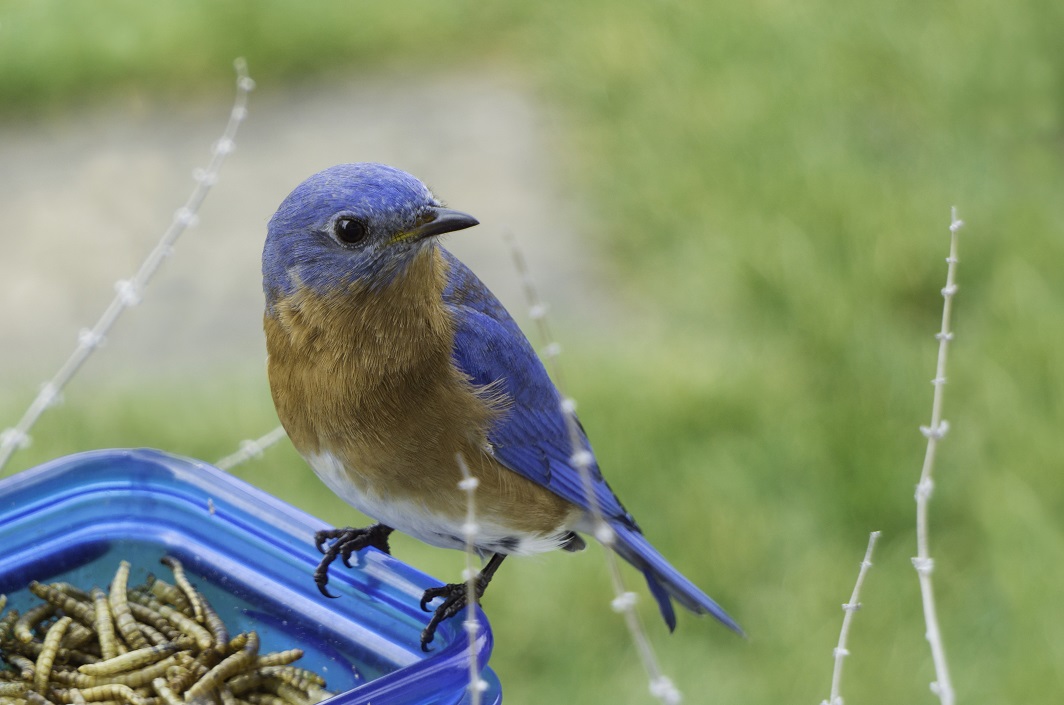
They are fairly easy to identify when you see them as they have a white belly with blue on top and a reddish-brown throat and breast.
Females are not as brightly coloured as the males and have a more blue-grey wings and tail.
Their diet consists of crickets, snails, worms, caterpillars, beetles and grasshoppers, but they also eat a wide variety of wild fruits including wild grapes, dogwood berries, blackberries and sumac.
These birds can be observed feeding when they perch on a high point, for example a fence post, and then swoop down to catch insects on the ground.
If there is an abundant source of food for the winter, these birds may not migrate south for the winter, but may stay around the area and they have been observed wintering in the areas on the north shores of Lake Ontario and Lake Erie.
If they do not head to warmer climes, they seek cover where there is warmth and a food source, such as in heavy thickets, woodlands or orchards where food and shelter is available.
Below, there is a charming video of the Eastern Bluebird, submitted by Arlene Marley, and shown here, thanks to Youtube!
Eastern Bluebird Info ...
All About Birds - The Eastern BluebirdExtensive information from the Cornell Lab of Ornithology
© Steve Byland | Dreamstime.com
© Charles Brutlag | Dreamstime.com