THE WILD TURKEY
(Meleagris gallopavo)
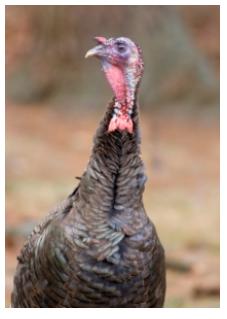
The Wild Turkey is native to North America and is common in this area of Southern Ontario.
We often see flocks of these birds in the fields in this area during the Autumn and Winter months, as the birds look for the last of the grain from the summer.
At the beginning of the 20th century the numbers of these birds had dwindled to such a point that they were in danger of extinction because of loss of habitat and over-hunting, but in 1984 they were re-introduced into this area.
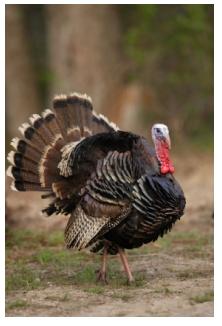
Recognized by their reddish coloured head, which is bereft of feathers, the males have a red throat.
Their bodies have dark brown, bronze or black plumage. Males have wattles on their throats and necks.
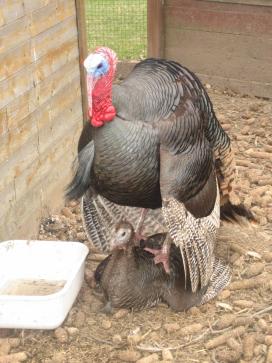
When excited the fleshy flap of skin on the throat and neck engorges with blood and becomes swollen.
These birds have four toes on each foot and males have rear spurs on their lower legs.
Identified by their long, dark, fan-shaped tail and glossy bronze wings and showing marked sexual dimorphism.
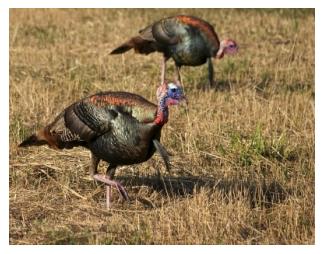
As you can see, the males are considerably larger than the females and the feathers of the male tend to show iridescent shades of purple, copper, green and gold.
The average female Turkey bird may weigh around 8 lbs (a little over 3 kg) with males weighing in much heavier at 18 lbs (8 kg)
In this picture, above, you can see the birds preparing for mating, and you can also see the size difference in the two birds - the male is much bigger than the female.
According to the National Wildlife Turkey Federation in the USA, the larges size recorded for an adult male wild turkey was 38 lbs - phew .... that is some Thanksgiving Dinner!
They tend to feed in woodlands, however, during the mating season they prefer open woods, fields and pastures. It seems that open areas near woods or brush give displaying males and the females they attract, a quick means of escape if danger approaches.
Hen wild turkeys nest on the ground, commonly at the base of a tree or bushes, or in long grass. At night, they roost in trees.
In the picture below, the colourful plumage of the male birds can be seen clearly.
These birds are true omnivores and will eat many different foods including acorns, hickory and hazel nuts, juniper and bearberry seeds and plant roots.
They are also known to eat some insects, small snakes and frogs, although experts consider grass to make up the majority of their diet.
In some areas of Southern Ontario the population of Meleagris gallopavo can reach large numbers because of the bird's ability to forage for many different types of food.
Early morning and late afternoon are the times when these birds are most frequently seen, as it is then that they eat.
Wild Turkey Info ...
National Geographic - North American Wild Turkey Information
Lots of info about the Turkey in North America