Lynx in Winter
by James
(Markham, Ontario, Canada)
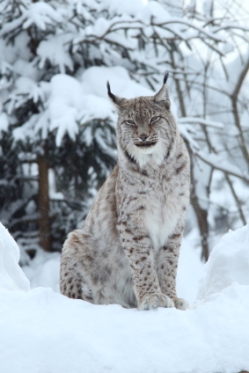

Lynx in the snow

My family owns a cottage in the Lake of Bays area. A few years ago, in the late 1990's, I was outside walking on the frozen bay, watching to see if any wildlife came out and about.
I looked across the bay with my binoculars, and saw this large cat-like figure, it was brown / grey, with a short stumpy tail, and big paws. It was just walking around the bush, looking for small mammals to eat. This was the first time that I have ever seen a Lynx in the wild.
This information was submitted by one of our readers who tells us about his sighting of a Lynx.
Thanks, James!
According to information from the Muskoka Wildlife Centre, the Lynx typifies what “built for snow” means!
With large feet is has built-in snowshoes, long legs, thick winter coat, icy stare and gray colouring, there is no place this wild cat is more at home than in the snow-covered forests of Northern Ontario.
These big cats weigh in at around 40lbs, which is considerably smaller than the Cougar, which often weighs up to 150 lbs.
An interesting characteristic that stands out is the Lynx’ ear tufts - some scientists believe that the purpose of these is something to do with sound channeling, while others claim they are a visual beacon for locating other Lynx - perhaps this is how cubs locate their mother in a snow storm.
The other most obvious trait is the short tail and again the purpose can only be speculated. Because these animals are deep forest dwellers, a long tail could get snagged or tangled, and they don’t run long distances through open areas, but instead opt to ambush their prey, therefore not needing a long tail for balance during a chase.
Wild populations of Lynx in Ontario are stable, but fragile, and because they prey almost exclusively on Snowshoe Hare their population as a whole hinges on the up and down cycles of Hare populations.
Sightings in the wild are very rare as the Lynx is very shy and cannot survive in disrupted forest.
Human development such as deforestation, pipeline construction, towns and roads drastically effect their survival rates.
I know our Facebook followers will find this interesting, so I will also post this on our Facebook page.

Comments for Lynx in Winter
|
||
|
||
|
||
|
||
|
||
|
||

