THE GARTER SNAKE
(Thamnophis sirtalis)
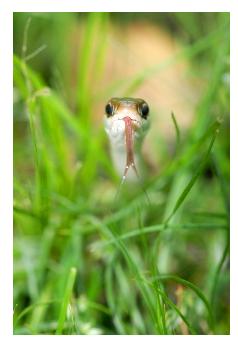
The Garter Snake, Thamnophis sirtalis is common in Southern Ontario, in fact, they belong to the most common genus of reptile in North America.
They are often called "Garden Snakes" and are known in the UK as "Grass Snakes" - they are harmless to humans and are often found on lawns and gardens.
We sometimes see them basking in the sunshine on warm summer days, often on our driveway, and sometimes in the composter, which can be a bit of a jolt when I first open the lid and see something slithering away, but after the initial shock, I realize what I have seen.
Sometimes we even find the recently shed skin of the snake, which is interesting to see.
These reptiles range across North America and are successful because they eat almost any food which is available, and are able to adapt to various climactic areas and many habitats, from grasslands to marshes, in dry or wet regions.
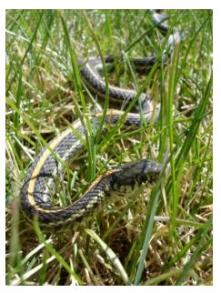
The colouration of these reptiles is commonly green, red or yellow stripes running lengthwise, but there is a great variety in the colour and patterning of different varieties of these animals.
Even within a species, the colour in the stripes, spots and background can differ from a deep red to a bright green.
Growing to a maximum length of around 24", most of these snakes have a lifespan of about 6 years.
These snakes, like all snakes, are carnivorous and their diet includes almost any creature that they are capable of catching - worms, slugs, insects, small lizards, spiders, amphibians - tadpoles & small fish, birds, and rodents, which they swallow whole.
These animals are often the prey of Hawks, Crows, Raccoons and Crayfish and even shrews and frogs will eat the juveniles.
Each winter, Garter Snakes hibernate in large groups in a den, called a Hibernaculum which is where hundreds of these snakes gather and hibernate for the winter. Many of these dens are used by the snakes year after year.
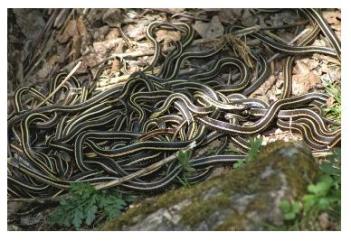
With the warm Spring weather, the hibernaculum starts to warm up and during the two weeks or so that this takes, the snakes slowly wake and occasionally take a short visit to the outside world.
Soon after waking from their hibernation, mating takes place.
After mating and a gestation period of between 2 - 3 months, the females give birth to between 3 and 50 babies, which are independent from birth and receive no maternal care at all.
Although long thought of as non-venomous, it has recently been learned that these snakes do actually produce a mild neurotoxin, however, they produce low amounts and are therefore, harmless to humans.
This video from YouTube shows Garter Snakes
Pictures courtesy of
8406786© Adam Borkowski| Dreamstime.com
© David Park | Dreamstime.com
© Muriel Kerr | Dreamstime.com
Garter Snake Info ...
The Garter Snake Info site
Lots of info about these interesting snakes



Recent Articles


-
The friendly Chickadee
Jan 29, 26 06:00 AM
-
The City of St Thomas
Jan 22, 26 07:00 AM
-
Leamington, Ontario
Jan 20, 26 10:00 AM