THE BADGER
(Taxidea taxus)
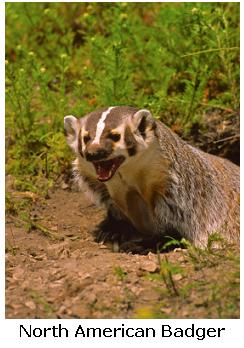
If you are one of the fortunate people who have seen a Badger in its natural habitat, then you are one of the lucky ones!
Today, these animals are so rare in Ontario, that experts think there may only be 200 of them remaining in the wild, and therefore they need our protection.
It isn't easy to mistake these animals for anything else - they are a little larger than a Raccoon with a black & white facial pattern, they are short in stature and have coarse grey fur.
They also have powerful legs, sharp, strong claws and these omnivores will eat almost anything, but mainly small mammals such as Groundhogs, Squirrels and Chipmunks - these guys are fast!
They also catch and eat Rabbits, Voles and Mice, lizards and amphibians and ground-nesting birds, but are not thought to prey on farm animals, so they are not a danger to livestock.
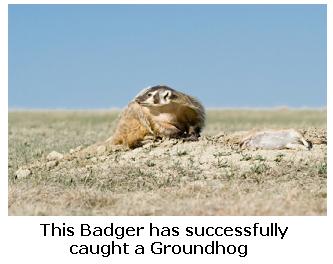
These nocturnal creatures are able to travel long distances and prefer to avoid human habitation, so are not often seen.
These creatures in Southern Ontario are not the same as the European type, and are a distinct and separate species - Taxidea taxus jacksoni.
Males are typically larger and heavier than females and measure up to 29 inches from nose to tail, with males weighing in at almost 20 lbs and females at 15 lbs.
When there is abundant food, these creatures eat well during the summer months, storing body fat for the lean winter months ahead.
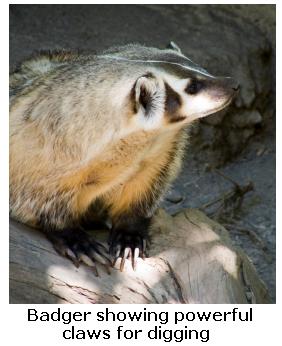
During most of the year, these are solitary animals, preferring to hunt and live alone, and only getting together with others for mating - the male is a gigolo who often mates with more than one female.
Mating takes place in the summer-time and the young are born in an underground burrow during the winter, and often up to five babies are born in a litter.
Since May 2000 these animals have been considered "Endangered" in Ontario and if one is sighted, you are requested to contact Ontario Badgers or call their toll-free number (1-877-715-9299) to report your sighting of "le blaireau", if you find a dead Badger or if you think you have found a burrow.
Badger Info ...
Ontario Badgers To report a sighting of a Badger, if you find a dead Badger or if you think you have found a burrow.
Graphics thanks to Istockphoto and JohnPitcher